bots
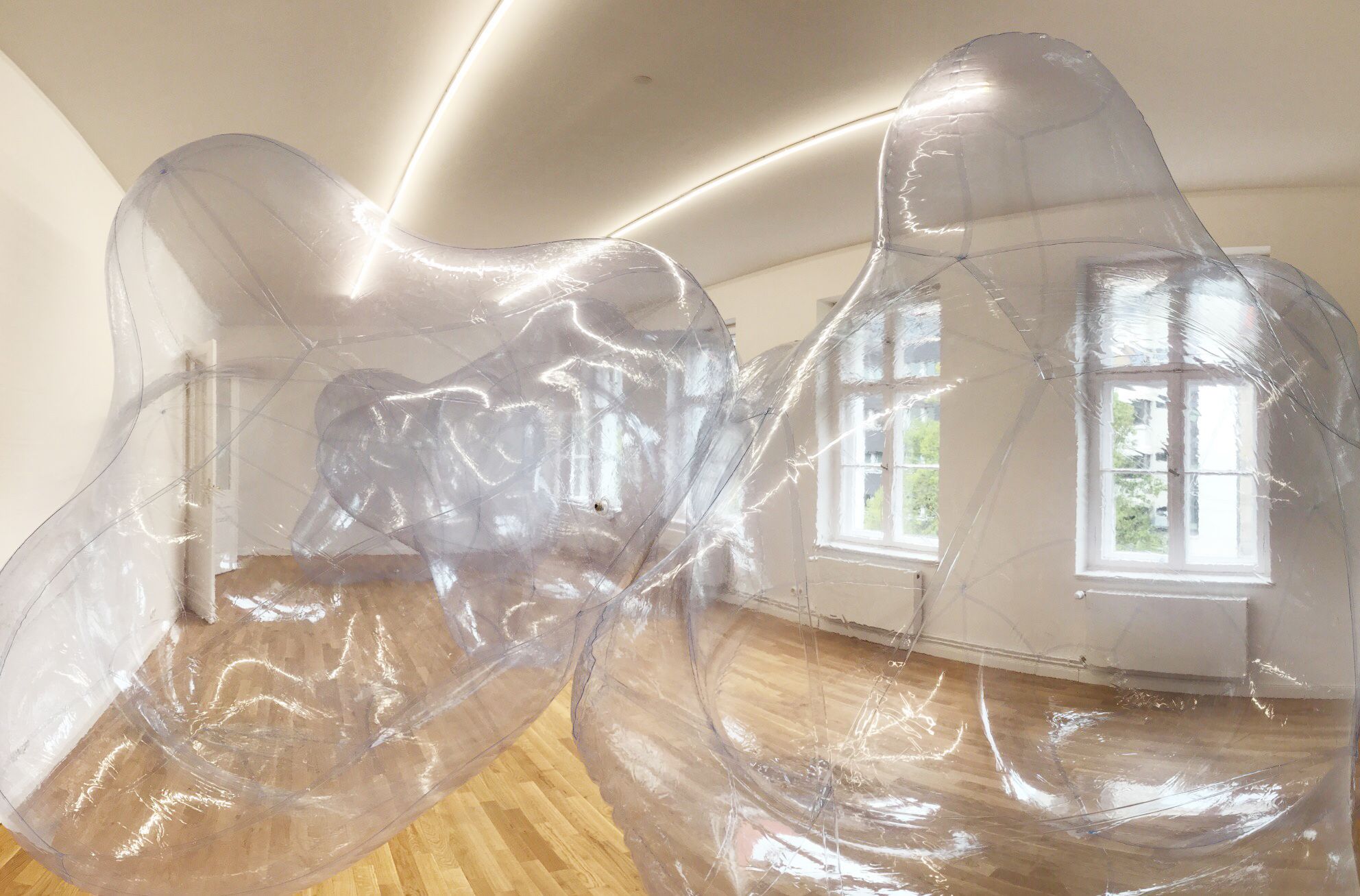
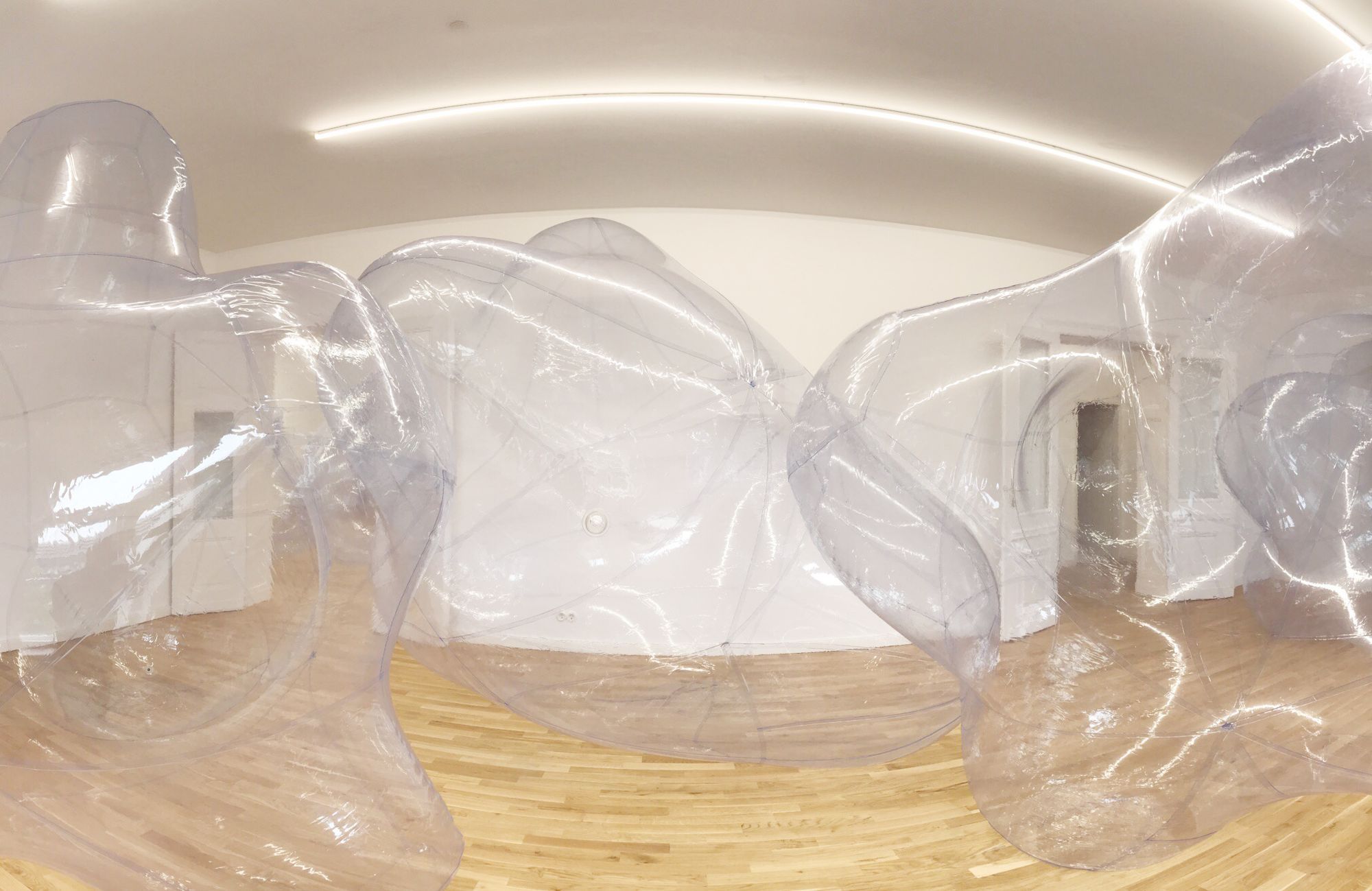
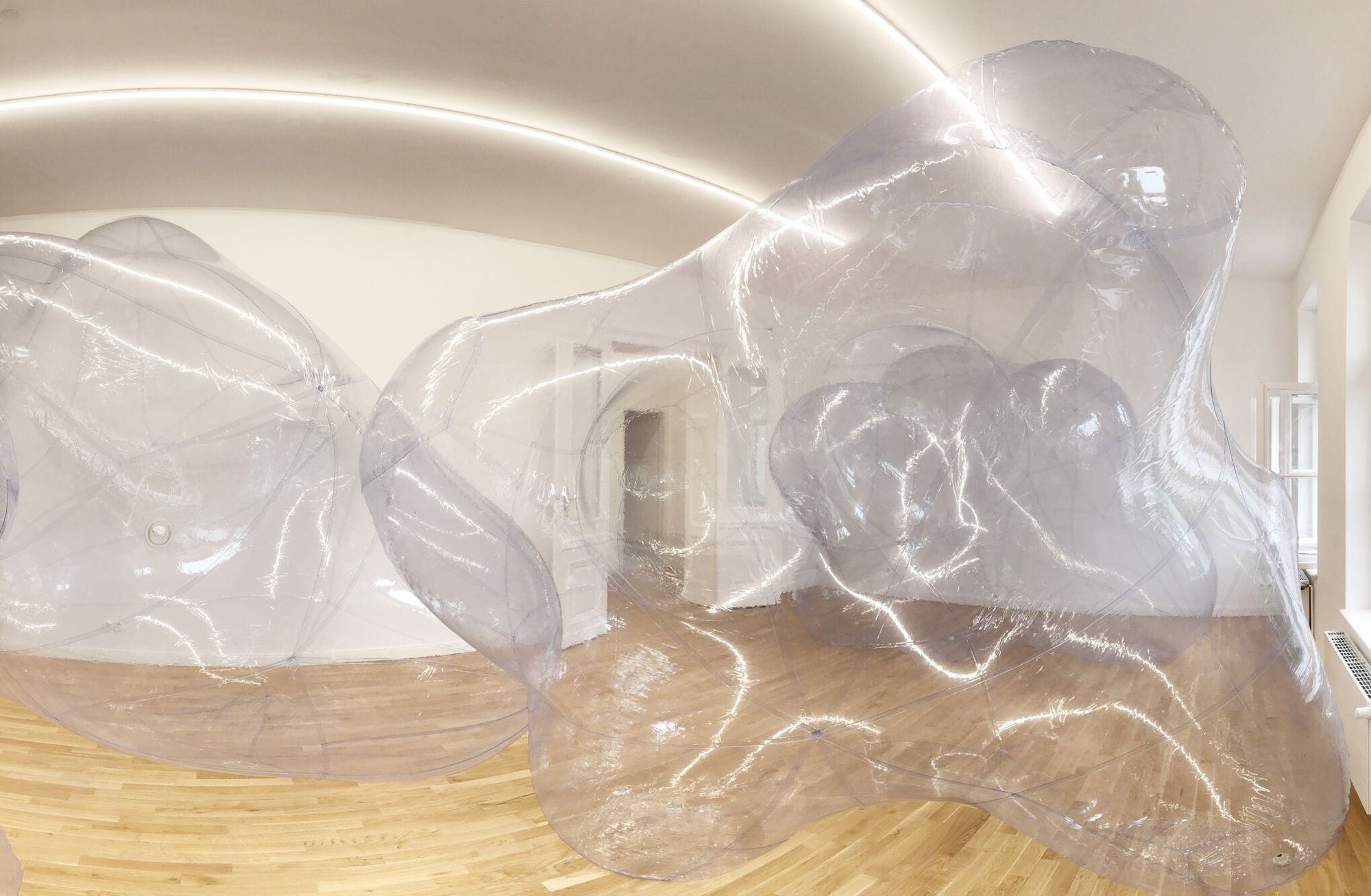
bots translates the vast, intangible volume of data in digital environments into an enterable physical structure.
Nine enormous inflatable forms, abstracted from molecular and particle models, are scaled far beyond the human body and occupy the entire exhibition space.
Data — ordinarily invisible, untouchable — here acquires volume, becoming a presence that presses.
These forms are at once light and immense, soft and obstructing. They carry no clear structural orientation, yet they stack, expand, and crowd one another in space, constraining the paths through which a viewer can move.
Visitors must detour, pass through, yield. The body is forced to find gaps between these swollen "data masses." The digital environment is no longer an abstract backdrop — it becomes a concrete, enclosing spatial experience.
Unlike conventional solid installations, these inflatable structures carry a kind of transparency. They are not rigid walls, but deformable, movable membrane-like forms.
Like digital systems themselves — appearing open, fluid, and boundless, while invisibly reshaping pathways of behavior and the range of action.
Through this transparent pressure, bots physicalizes the structural control embedded in digitized reality, letting visitors experience a condition of being surrounded yet unable to clearly locate the boundary.
"Bots" refers not only to automated programs or web crawlers, but also to the position of the individual within a fully digitized environment.
When daily life is decomposed into particle-level data points, when behavior is reorganized by algorithmic structures, is the individual still actively participating? Or gradually becoming an automatically executing unit within a system of rules?
In this space composed of "molecules," the boundary between subject and program begins to blur.
bots makes no critique through direct imagery or narrative. Instead, through the conversion of scale and volume, it gives invisible structures a bodily sensation.
What visitors enter is not only an installation space, but an environment amplified by data. Within that environment, pressure and transparency coexist; participation and being-controlled intertwine.
The work invites visitors to recognize: in a digital world that appears open, the position we occupy may already have been structurally predetermined.
A collaboration with aaajiao.
---
layout: work.njk
title_zh: bots
title_ja: bots
title_en: bots
year: 2018
cover: /images/2018-bots/bots_1.jpg
materials: PVC气体模型
materials_ja: PVC エア彫刻
materials_en: PVC inflatable models
description: "Nine enormous inflatable forms abstracted from molecular models, translating the invisible volume of data into a physically enclosing spatial experience."
workTags:
  - installation
  - object
---

<div class="gallery">
    <img loading="lazy" src="/images/2018-bots/bots_1.jpg" alt="bots — 充气结构展览空间">
    <img loading="lazy" src="/images/2018-bots/bots_2.jpg" alt="bots — 充气形态近景">
    <img loading="lazy" src="/images/2018-bots/bots_3.jpg" alt="bots — 观众与装置">
</div>

<div lang="zh">

《bots》将数字环境中庞大而无形的数据体量
转译为一种可进入的物理结构。

九个巨大的充气形态
抽象自分子与粒子模型,
被放大到超越人体尺度,
占据整个展厅空间。

原本不可见、不可触摸的数据
在这里获得体积,
成为一种压迫性的存在。

这些形态既轻盈又庞大,
既柔软又阻挡。
它们不具备明确的结构指向,
却在空间中彼此堆叠、扩张,
限制观众的移动路径。

观众必须绕行、穿行、退让,
身体被迫在这些膨胀的"数据团块"之间寻找缝隙。
数字环境不再是抽象背景,
而成为一种具体的、围困式的空间体验。

与传统实体装置不同,
这些充气结构具有某种"透明性"。
它们并非坚硬的墙体,
而是可变形、可移动的膜状存在。

正如数字系统本身——
看似开放、流动、无边界,
却在无形中重塑行为路径与行动范围。

《bots》通过这种透明的压迫,
将数字化现实中的结构性控制物理化,
使观众在空间中体验到一种
被包围却难以明确指出边界的状态。

"bots"不仅指向自动化程序或网络爬虫,
也隐喻个体在全面数字化环境中的位置。

当日常生活被拆解为粒子级别的数据点,
当行为被算法结构重新组织,
个体是否仍然在主动参与?
抑或逐渐成为规则系统中的自动执行单位?

在这个由"分子"构成的空间中,
主体与程序之间的界限开始变得模糊。

《bots》并不通过直接的图像或叙事表达批判,
而是通过尺度与体量的转换,
使不可见的结构获得身体感。

观众进入的不只是一个装置空间,
而是一种被数据放大的环境。
在这种环境中,压迫与透明共存,
参与与被控制交织。

作品邀请观者意识到:
在看似开放的数字世界中,
我们所处的位置,
或许早已被结构预设。

作品与 [aaajiao](https://eventstructure.com) 合作完成。

</div>

<div lang="ja">

《bots》は、デジタル環境における
膨大で不可視のデータ体積を、
入ることのできる物理的な構造へと翻訳する。

分子と粒子モデルから抽象された
九つの巨大なインフレータブル形態が、
人体のスケールをはるかに超えて膨張し、
展示空間全体を占有する。

本来は不可視で、触れることのできないデータが、
ここで体積を獲得し、
圧迫的な存在となる。

これらの形態は、軽くもあり巨大でもあり、
柔らかくもあり、遮るものでもある。
明確な構造的方向性は持たないが、
空間の中で互いに積み重なり、膨張し、
観者の移動経路を制限する。

観者は迂回し、くぐり抜け、退かなければならない。
身体は、これらの膨らんだ"データの塊"のあいだに
隙間を探すことを余儀なくされる。
デジタル環境はもはや抽象的な背景ではなく、
具体的で、包囲的な空間体験となる。

従来の物質的インスタレーションとは異なり、
これらのインフレータブル構造はある種の"透明性"を持つ。
硬い壁ではなく、
変形し、動かすことのできる膜状の存在だ。

デジタルシステムそのもののように——
開かれ、流動的で、境界がないように見えながら、
行動の経路と行動範囲を
見えない形で作り変えていく。

《bots》は、この透明な圧迫を通じて、
デジタル化された現実における構造的な制御を身体化し、
観者に、包囲されていながらも
境界を明確に指し示すことのできない状態を体験させる。

"bots"とは、自動化プログラムやウェブクローラーを指すだけでなく、
全面的にデジタル化された環境における
個人の位置をも隠喩する。

日常生活が粒子レベルのデータポイントへと分解され、
行動がアルゴリズム的構造によって再編成されるとき、
個体はなお能動的に参加しているのか?
あるいは、規則のシステムの中で
自動実行される単位へと徐々に変化しているのか?

"分子"によって構成されたこの空間の中で、
主体とプログラムのあいだの境界線が
揺らぎはじめる。

《bots》は、直接的なイメージや物語によって批判を表明するのではなく、
スケールと体積の転換を通じて、
不可視の構造に身体的感覚を与える。

観者が入るのは、単なるインスタレーション空間ではなく、
データによって拡大された環境だ。
その環境の中で、圧迫と透明性が共存し、
参与と制御の交錯が生まれる。

作品は観者に気づかせようとする:
開かれているように見えるデジタルの世界において、
私たちが置かれている位置は、
あるいはすでに構造によって予め設定されているのではないか、と。

[aaajiao](https://eventstructure.com) との共同制作。

</div>

<div lang="en">

*bots* translates the vast, intangible volume of data in digital environments
into an enterable physical structure.

Nine enormous inflatable forms,
abstracted from molecular and particle models,
are scaled far beyond the human body
and occupy the entire exhibition space.

Data — ordinarily invisible, untouchable —
here acquires volume,
becoming a presence that presses.

These forms are at once light and immense,
soft and obstructing.
They carry no clear structural orientation,
yet they stack, expand, and crowd one another in space,
constraining the paths through which a viewer can move.

Visitors must detour, pass through, yield.
The body is forced to find gaps
between these swollen "data masses."
The digital environment is no longer an abstract backdrop —
it becomes a concrete, enclosing spatial experience.

Unlike conventional solid installations,
these inflatable structures carry a kind of *transparency.*
They are not rigid walls,
but deformable, movable membrane-like forms.

Like digital systems themselves —
appearing open, fluid, and boundless,
while invisibly reshaping pathways of behavior and the range of action.

Through this transparent pressure,
*bots* physicalizes the structural control embedded in digitized reality,
letting visitors experience a condition of being surrounded
yet unable to clearly locate the boundary.

"Bots" refers not only to automated programs or web crawlers,
but also to the position of the individual
within a fully digitized environment.

When daily life is decomposed into particle-level data points,
when behavior is reorganized by algorithmic structures,
is the individual still actively participating?
Or gradually becoming an automatically executing unit
within a system of rules?

In this space composed of "molecules,"
the boundary between subject and program
begins to blur.

*bots* makes no critique through direct imagery or narrative.
Instead, through the conversion of scale and volume,
it gives invisible structures a bodily sensation.

What visitors enter is not only an installation space,
but an environment amplified by data.
Within that environment, pressure and transparency coexist;
participation and being-controlled intertwine.

The work invites visitors to recognize:
in a digital world that appears open,
the position we occupy
may already have been structurally predetermined.

A collaboration with [aaajiao](https://eventstructure.com).

</div>