The Problem in Open Data Is Not the Data, but the Operations
Open Data in Japan has matured rapidly. More municipalities now run their own catalogs, and the volume and diversity of public datasets keep growing. But the moment Open Data leaves the "publishing" phase and enters daily operation, a recognizable set of global challenges appears:
- Inconsistent structures and formats
- Maintenance and updates relying on individual effort
- Difficulty coordinating across departments
- Limited connection between catalogs and databases
- Data that is published but not easily consumable by systems or applications
These are not the shortcomings of any single organization — they are the shape of Open Data operations worldwide. Data can be published; sustaining, structuring, and integrating it is the harder problem.
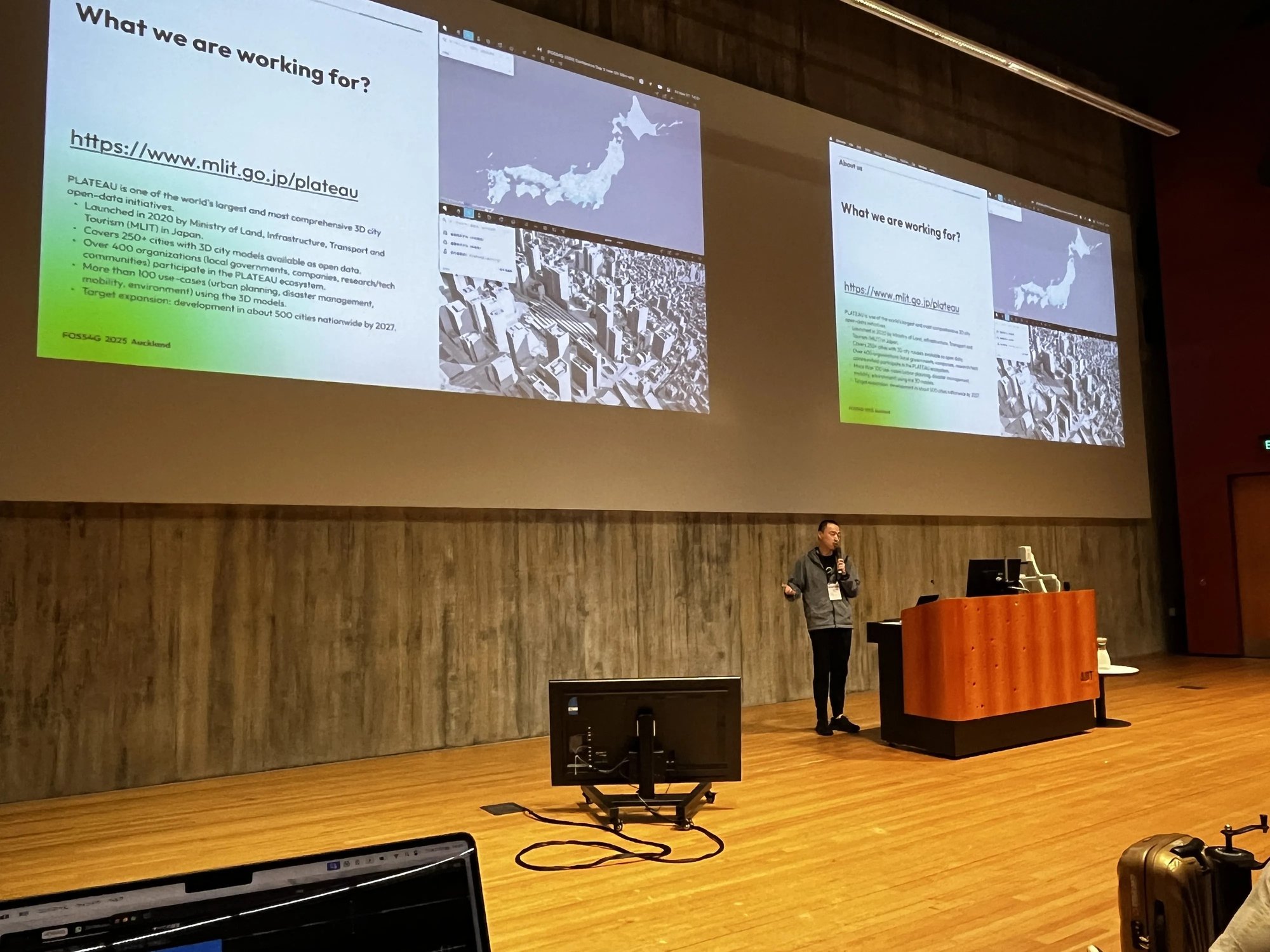
In this talk I reframed Open Data through the lens of operations rather than publishing, and shared one of the directions our team has been exploring: treating each dataset as a structured, collaboratively editable, API-ready object — managed in a lightweight, multi-user CMS that our team builds in the open (Re:Earth CMS). The aim is to close the gap between Open Data catalogs and the urban systems, visualization tools, and civic technology that actually consume them.
Open Data is not a one-time publication. It is a continuous practice — and the tools we use to operate it matter as much as the policies that drive it.
---
layout: talk.njk
title_zh: "Open Data 真正的难题不是数据本身,而是运营"
title_ja: "オープンデータの本当の課題は「データ」ではなく「運用」だ"
title_en: "The Problem in Open Data Is Not the Data, but the Operations"
year: 2025
event: FOSS4G 2025
eventUrl: https://2025.foss4g.org/
role: speaker
location: 奥克兰,新西兰
location_ja: オークランド、ニュージーランド
location_en: Auckland, New Zealand
cover: /images/talks/foss4g-2025-open-data-operations/hero.jpg
description: "Open Data in Japan is growing, but daily operations — structuring, updating, and cross-team management — remain challenging. A look at what those operational challenges actually feel like, and one lightweight, open-source approach our team has been exploring to make Open Data more usable and sustainable."
videos:
  - url: https://www.youtube.com/watch?v=kVBABnRnslw
    title: 官方录像
    title_ja: 公式録画
    title_en: Official conference recording
workTags:
  - talk
---

<div lang="zh">

日本的 Open Data 正在快速走向成熟。越来越多的自治体在运营自己的数据目录,公开数据集的规模和种类也在持续增长。但一旦 Open Data 离开「发布」阶段,进入日常运营,一组在全球范围内都很熟悉的问题就会浮现出来:

- 结构和格式各搞各的
- 维护和更新主要靠个人在硬撑
- 跨部门协作很难推动
- 数据目录和数据库之间几乎没有真正连通
- 数据是公开了,但很难被系统或应用直接拿去用

这些不是某一家组织的疏漏,而是全球 Open Data 运营所共有的形态。把数据公开出来并不难,难的是把它持续维护、组织起来、再接到下游系统里。

在这次演讲中,我把 Open Data 从「发布」切换到「运营」的视角来重新讲述,并分享了我们团队正在探索的方向之一:把每一份数据集都当成一个结构化、可以多人一起编辑、随时能作为 API 被调用的「对象」,并在一个轻量、多人协作的 CMS 上把它们运营起来(具体实现是我们团队在公开开发的 Re:Earth CMS)。目标是把 Open Data 目录和那些真正在用它们的下游系统连接起来——城市系统、可视化工具、civic tech 应用都包括在内。

Open Data 不是一次性的发布,而是一件要一直做下去的事。我们用什么工具去运营它,和我们出台什么政策同样重要。

</div>

<div lang="ja">

日本のオープンデータは急速に成熟してきた。自前のカタログを運用する自治体は増え、公開されるデータセットの量と多様性も増し続けている。だがオープンデータが「公開」のフェーズを離れて日々の運用に入った瞬間、世界共通の課題が立ち上がってくる。

- 構造もフォーマットもバラバラ
- メンテナンスと更新が個人の踏ん張りに依存している
- 部署をまたいだ調整が難しい
- カタログとデータベースがほとんど繋がっていない
- 公開はされているが、システムやアプリから扱いやすい形にはなっていない

これらはどこか一つの組織の落ち度ではない。世界中のオープンデータ運用が抱えている形そのものだ。データを公開することはできる。難しいのは、それを維持し、整理し、つなぎ込むほうである。

この登壇では、オープンデータを「公開」ではなく「運用」のレンズで捉え直し、私たちのチームが探っている方向性のひとつを共有した。すなわち、それぞれのデータセットを、構造化され、みんなで編集でき、API としてすぐに使える「オブジェクト」として扱うこと──そして、それを軽量で、複数人が同時に使える CMS の上で運用していくこと(実装としては、私たちのチームがオープンに開発している Re:Earth CMS を用いている)。狙いは、オープンデータのカタログと、それを実際に使う都市システム、可視化ツール、シビックテックとの間の隙間を埋めることにある。

オープンデータは一度公開して終わるものではなく、ずっと続けていく実践だ。その運用を支える道具は、政策と同じくらい重要である。

</div>

<div lang="en">

Open Data in Japan has matured rapidly. More municipalities now run their own catalogs, and the volume and diversity of public datasets keep growing. But the moment Open Data leaves the "publishing" phase and enters daily operation, a recognizable set of global challenges appears:

- Inconsistent structures and formats
- Maintenance and updates relying on individual effort
- Difficulty coordinating across departments
- Limited connection between catalogs and databases
- Data that is published but not easily consumable by systems or applications

These are not the shortcomings of any single organization — they are the shape of Open Data operations worldwide. Data can be published; sustaining, structuring, and integrating it is the harder problem.

In this talk I reframed Open Data through the lens of operations rather than publishing, and shared one of the directions our team has been exploring: treating each dataset as a structured, collaboratively editable, API-ready object — managed in a lightweight, multi-user CMS that our team builds in the open (Re:Earth CMS). The aim is to close the gap between Open Data catalogs and the urban systems, visualization tools, and civic technology that actually consume them.

Open Data is not a one-time publication. It is a continuous practice — and the tools we use to operate it matter as much as the policies that drive it.

</div>

<div class="gallery">
  <img src="/images/talks/foss4g-2025-open-data-operations/hero.jpg" alt="FOSS4G 2025 奥克兰大会现场演讲">
</div>